Study / Volatility
On a fall, index puts kept their re-mark at the bid. Single-name puts did not.
On a fall, a held index put keeps its re-mark at the bid; a held single-name put's mostly goes in the spread. The top-50 names' held 25-delta puts re-mark more than SPY's at mid, about 0.67 against 0.41 vol points per 1% fall, but at the bid the names keep about a tenth of it and SPY keeps 86% of its own.
Reading guide
One reading for a book that pays carry all year for a multiple on the bad day: of the re-mark a held put shows on the fall day, what survives the bid, on the index and on single names. Then how firm it is, what it is not, and the desk's own test.
What a convexity book pays for
A convexity book pays carry all year for a multiple on the bad day, and it exits at the bid. This study reads what a held put's re-mark on the day of an ordinary fall is worth there: on the index, most of it; on single names, about a tenth. Two neighbouring readings, how much of a surface move reaches a held strike at all and how the cost of entry changed over the decade, are in More tilt, less level.
None of this says what a 7% drop day does. Each reading here answers a question a convexity desk already asks, and each is a measurement to set beside the desk's own book, under a rule frozen before anyone looks.
On a fall, a held index put keeps its re-mark at the bid; a single-name put's mostly goes in the spread
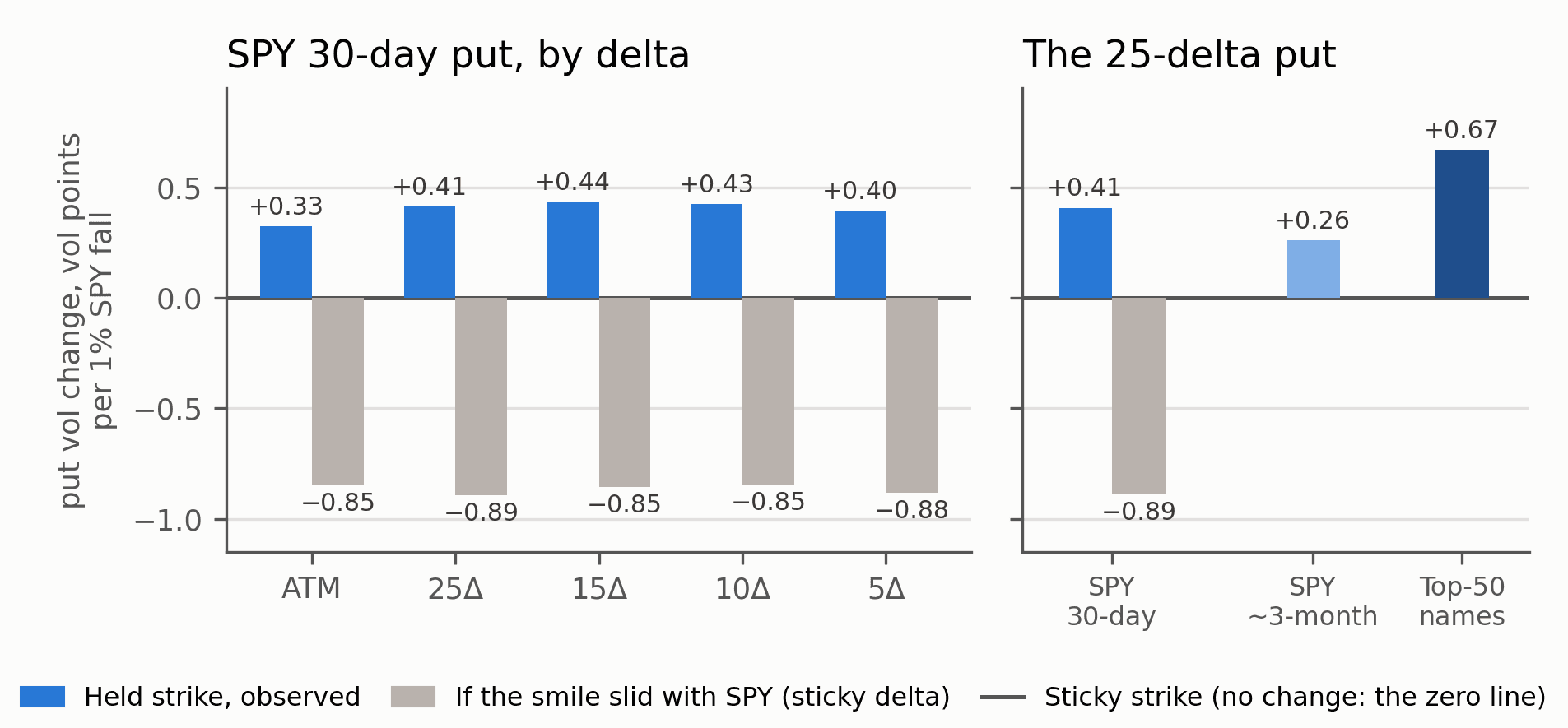
We hold the put strike chosen on the prior session, on its listed expiry, through 304 close-to-close SPY falls of 0.5–2% between 2015 and 2025, matched on direction, size and the basket's prior 30-day implied volatility, and read its vol change once, under a protocol fixed in advance, in vol points per 1% fall. The market marks the held strike up: beyond sticky strike, where its vol would not move, and the opposite of sticky delta, where the smile slides with SPY and marks it down. The volatility-regime literature calls this a skew stickiness ratio above one. [1] [2]
At the bid. The top-50 names' held 25-delta puts re-mark more than SPY's: about 0.67 vol points at mid, IVV-weighted, against SPY's 0.41. At the bid, the names keep about a tenth of their re-mark and SPY keeps 86% of its own. [3] The bid reading is the fall day's bid against the prior session's mid, so it is the exit side, on the fall day itself. On the names, crossing the spread takes most of the re-mark.
Across the wing and the curve, at mid. About the same from the 25- to the 5-delta put, 0.40 to 0.44, so the far wing does not re-mark more in vol points, and lower at the money, 0.33. The bid was read at the 25-delta strike only. On a listed expiry about three months out, a median of 91 days, the reading is about 0.6 of the 30-day reading.
How firm it is. The 30-day 25-delta reading is about 0.41 vol points per 1% fall on 294 days, against −0.83 to −0.89 had the smile slid with SPY. With each year left out in turn it stays between 0.37 and 0.44, and this listed-expiry reading agrees with the constant-maturity reading in More tilt, less level within 0.05 in every period. [3]
The checks behind the reading
| Check | Reading |
|---|---|
| Share of the re-mark kept at the bid, SPY's held 30-day 25-delta put | 86% |
| Share kept at the bid, the top-50 names' held 25-delta puts, index-weighted | 9% |
| SPY's 30-day 25-delta re-mark with each year left out in turn, vol points per 1% fall | 0.37 to 0.44 |
| Largest gap to the constant-maturity reading of More tilt, less level in any period, vol points | 0.04 |
Table 1. The checks behind this study, each read once under its own protocol, on the matched 0.5–2% SPY falls of 2015–2025. The bid reading is the fall day's bid against the prior session's mid. [3]
The held strike is read on its listed expiry, so the expiry is real and the strike is held; what is synthetic is nothing. On 281 to 294 of the 304 matched days the held quotes exist on both sides. The index reading was largely known before the protocol was fixed; the bid readings and the single-name comparison were read once under it.
What it is not
A vol change at a held strike on the 15:46 ET snapshot, at mid except the bid readings above, without fills, and not a put's profit. Spot, decay and the cost of a trade are outside it, and so are the sessions after the fall and a 7% day. Much of the index reading had been seen before the protocol was fixed, so it is a restatement, not a fresh test.
The desk's own test
The test is the desk's own: its held contracts, with real strikes, tenors and fills, split into spot, level and shape parts and set beside the same book under a rule frozen before anyone looks, after premium, spreads and financing. The readings here describe past SPY and constituent quotes; they are not a forecast or a recommendation.
Sources
[1] Derman, E. "Regimes of Volatility." Risk 12(4), April 1999, 55–59; first issued as Goldman Sachs Quantitative Strategies Research Notes, January 1999.
[2] Bergomi, L. "Smile Dynamics IV." Risk, December 2009, 94–100, which introduces the skew stickiness ratio: 1 under sticky strike, 0 under sticky delta.
[3] Altus Works. Data and methods notes, October 2026, available to reviewers on request: the point-in-time fifty largest constituents of the US large-cap index, 30-day constant-maturity implied volatility built from option quotes, adjusted closes, the terrain and fragility readings as published by the Altus terminal on 9 October 2026, and, for each exhibit, the protocol, code and checks behind it.
Where the interpretation ends
A vol change at a held strike on the 15:46 ET snapshot, at mid except the bid readings, without fills, and not a put's profit: spot, decay and the cost of a trade are outside it, and so are the sessions after the fall and a 7% day. Much of the index reading had been seen before the protocol was fixed, so it is a restatement, not a fresh test.
Descriptive measurement of past market data. No portfolio holdings are analysed and no investment or trading recommendation is made.
Important information
This item describes measurements of past market data: developed history from one dataset over one window, January 2015 to December 2025, with option marks from one quote snapshot at mid, without fills. It does not establish predictive ability or trading profitability, and nothing here is investment advice, a recommendation to transact, or an offer or solicitation concerning any investment. Option and index data are licensed from third parties and remain subject to their terms. Altus Works develops the measurements and the Terminal described and has a commercial interest in their adoption.